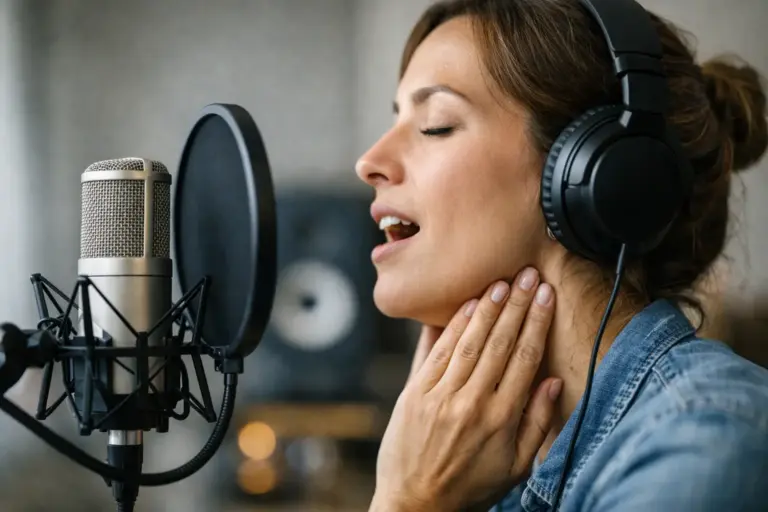
How to Overcome Performance Anxiety
A shaky breath, a dry mouth, a racing heart - most performers and speakers know that moment when the body seems to forget everything the mind has prepared. If you are asking how to overcome performance anxiety, the first thing to understand is that nerves are not proof that you are unprepared or untalented. More often, they are a sign that what you are doing matters to you.
For singers, performance anxiety can interfere with breath flow, pitch stability, resonance, and phrasing. For speakers, it can flatten vocal variety, speed up delivery, tighten the throat, and make even a well-structured message sound uncertain. The problem is not simply emotional. It is physical, vocal, and behavioral. That is why generic advice to just relax rarely helps.
I'm John J Norton, a professional singer and vocal coach. I teach one-to-one online, wherever you are in the world. Book a free 15-minute call.
The better approach is to train for pressure in a way that respects how the voice actually works. Anxiety can be reduced, but it usually is not eliminated through positive thinking alone. It improves when you build a more dependable technique, a better pre-performance routine, and a more realistic relationship with the moment itself.
Why performance anxiety happens
Performance anxiety is the body preparing for threat, even when the threat is only social or imagined. You step into a room, onto a stage, or in front of a camera, and your system shifts into protection mode. Breathing becomes shallower. Muscles tighten. Attention narrows. The voice, which depends on coordinated freedom rather than force, becomes harder to manage.
This is one reason talented people can underperform in situations that matter. They may sing beautifully in a lesson and then feel unsteady at an audition. They may speak clearly in conversation and then sound thin or rushed in a boardroom. The issue is not always lack of skill. It is often that the skill has not yet been trained under stress.
There is also a psychological layer. Many people connect performance with judgment, and judgment with identity. A missed note starts to feel like a personal failure. A slight vocal wobble becomes evidence that you are not credible. When that happens, anxiety feeds on itself.
How to overcome performance anxiety without fighting yourself
Trying to suppress anxiety completely can make it stronger. A more effective strategy is to lower its impact on your voice and attention. You do that by giving the body a different job.
Start with breath, but not in the vague sense of taking a deep breath and hoping for calm. Deep breaths taken high into the chest often increase tension. What helps is low, easy inhalation followed by controlled, unforced exhalation. For singers, this supports steadier onset and phrase control. For speakers, it slows the pace and improves authority.
Then pay attention to physical excess. Anxiety often creates unnecessary effort in the jaw, tongue, neck, shoulders, and upper chest. Those areas can disrupt tone and clarity quickly. A brief release routine before you perform can make a substantial difference. Gentle neck mobility, jaw release, lip trills, humming, and easy voiced slides help restore coordination without overworking the instrument.
Mental framing matters too, but it needs to be credible. Telling yourself I am not nervous when you clearly are rarely works. A better statement is something like, My body is activated, and I know how to use that energy. This does not deny the sensation. It gives it direction.
Preparation should match the real pressure
One of the most common causes of performance anxiety is practicing in conditions that are too comfortable. If every rehearsal is private, controlled, and restart-friendly, the real event will feel like a different sport.
Pressure-proof preparation means introducing small amounts of exposure before the main performance. Sing or speak for one trusted person, then a few. Record yourself in one take. Practice entering the room, beginning without apology, and continuing after minor mistakes. Rehearse the opening lines until they feel especially secure. The first thirty seconds often determine whether anxiety escalates or settles.
This is where many performers make an avoidable mistake. They use practice to hunt for flaws rather than to build consistency. Of course, technical work matters. But if your rehearsal habit is constant criticism, your nervous system starts to associate performance with danger. Useful preparation is demanding, but it is not punitive.
The vocal habits that make anxiety worse
Some anxiety is emotional, but some is amplified by technique problems that become obvious under pressure. Weak breath management, a pressed onset, tongue tension, poor pacing, and trying to sound bigger than you are can all make nerves feel worse.
For singers, over-singing is a frequent culprit. When anxiety rises, many people push for security and end up losing freedom. They reach for volume instead of resonance, or force intensity instead of allowing it. The result is often instability in pitch, tightness at the top of the range, and fatigue.
For speakers, the equivalent is performing confidence rather than speaking with grounded intention. The voice becomes louder but less connected. Sentences rush. Emphasis becomes random. You may sound more strained, not more persuasive.
This is why individualized coaching can be so valuable. The solution depends on the pattern. One person needs steadier airflow. Another needs a freer jaw. Another needs to stop rehearsing emotionally before the voice is technically organized. Anxiety may look similar from the outside, but its triggers are not identical.
A pre-performance routine that actually helps
When people ask how to overcome performance anxiety, they often want a quick fix for the final five minutes before they begin. The truth is that the best pre-performance routine starts earlier than that, but the final minutes still matter.
Aim for a sequence that is predictable and simple. Not dramatic. Not superstitious. Predictability tells the nervous system that this moment is familiar.
Begin by arriving earlier than you think you need to. Rushing is one of the fastest ways to increase vocal tension. Give yourself time to settle physically, orient to the space, and test your speaking or singing voice at an easy level.
Warm up progressively. Do not save your full voice for the first line in public, but do not exhaust yourself beforehand either. Gentle coordination comes first, then more specific work related to your task. A singer preparing for lyrical phrasing needs a different warm-up from a professional about to lead a presentation, but both benefit from calm breath, easy phonation, and clear articulation.
Finally, narrow your attention. Do not try to manage every possible variable. Focus on two or three anchors: your breath release, your first phrase, and your connection to the text or message. When attention is scattered, anxiety grows.
What to do in the moment if nerves spike
Even strong performers have off moments. The goal is not perfect control. It is fast recovery.
If your heart starts racing, lengthen the exhale slightly before your next phrase. If your mouth is dry, pause rather than pushing through in a panic. If you make a mistake, keep the structure moving. Most audiences notice discomfort more than they notice the original error.
This is especially true for speakers. A brief pause can read as composure if you stay physically organized. For singers, a small technical reset between phrases is often enough to restore balance. The instinct to force your way out of the problem usually makes it more obvious.
It also helps to remember that audience perception is rarely as harsh as self-perception. What feels enormous from inside your body may barely register from the other side of the room.
When confidence comes after skill, not before
Confidence is often treated as the starting point. In practice, it usually arrives as the result of repeated evidence. You trust yourself because you have learned what to do when things are not perfect.
That is an important distinction. Real confidence is not the absence of nerves. It is the presence of usable technique, preparation, and recovery skills. Once those are in place, anxiety loses some of its authority.
At John J Norton Voice Zone, this is the kind of work that matters most - not just helping someone sound better on a good day, but helping them remain functional and expressive when the stakes feel high. That applies whether you are singing a demanding piece, leading a presentation, or speaking in a room where your voice shapes how you are perceived.
If performance anxiety has been shrinking your voice, do not treat it as a character flaw. Treat it as a trainable response. With the right technical support and the right preparation habits, pressure stops being a wall and becomes something you can work with. Sometimes the breakthrough is not becoming fearless. It is learning that your voice can stay with you, even when your nerves show up.
Want to work on this with me?
I'm John J Norton, a professional singer and vocal coach. I teach one-to-one online, wherever you are in the world.
Want to go beyond reading?
Put this into practice with my step-by-step online course — the first 3 lessons are free to try.
Explore the Online Singing Course