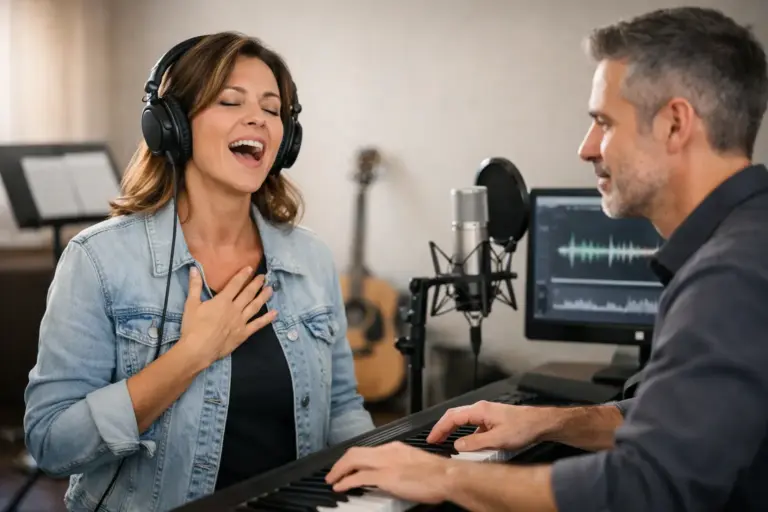
Voice Coaching vs Singing Lessons
Some people come to a first session saying, "I want to sing better." Others say, "I need my voice to stop letting me down." That difference matters. When comparing voice coaching vs singing lessons, the right choice depends less on the label and more on what you need your voice to do consistently, confidently, and without strain.
The two terms are often used as if they mean the same thing. Sometimes they overlap. A skilled teacher may offer both. But they are not always identical in focus, method, or outcome. If you are trying to improve tone, pitch, range, breath support, or performance, the distinction can save you time and frustration.
I'm John J Norton, a professional singer and vocal coach. I teach one-to-one online, wherever you are in the world. Book a free 15-minute call.
Voice coaching vs singing lessons: what is the difference?
At its simplest, singing lessons usually center on learning how to sing songs better. That can include pitch accuracy, rhythm, style, diction, musicality, and repertoire. A strong singing lesson often helps a student become more expressive and more technically reliable within the context of actual music.
Voice coaching tends to go deeper into how the voice functions and how to use it with greater efficiency. In a singing context, that can mean working on vocal production, resonance, registration, breath coordination, release of tension, consistency, stamina, and healthy technique. In some settings, voice coaching also extends beyond singing into speaking voice development, especially for professionals who need clarity, authority, and presence.
This is where the comparison becomes useful. If your main problem is learning songs, improving interpretation, and becoming more musical, singing lessons may be the right fit. If your main problem is that your voice feels unstable, tired, strained, breathy, tight, or inconsistent, voice coaching may be the better starting point.
Of course, the best work often blends both. Technique without application can feel abstract. Repertoire without technical development can leave the same problems unresolved.
What singing lessons usually focus on
A good singing lesson often begins with the music itself. You might work on phrasing, pitch, rhythm, style, articulation, memorization, and performance choices. For beginners, this can be the most engaging way to learn because the progress feels concrete. You sing a song, identify what is not working, and improve it piece by piece.
Singing lessons are especially useful if you want to prepare for auditions, learn genre-specific skills, expand your repertoire, or build confidence performing in front of others. If you already have a reasonably healthy vocal setup, this route can produce excellent results.
That said, some singing lessons stay too close to the surface. A student may be told to "support more" or "open up" without a clear explanation of what the body should actually do. If the teaching is heavily song-based but light on functional guidance, recurring technical issues may linger for months.
That does not mean singing lessons are less serious. It means the quality and scope vary. Some are musically focused. Some are technique-rich. The label alone does not tell you enough.
What voice coaching usually addresses
Voice coaching often starts with the instrument rather than the song. The goal is to improve how the voice is produced, coordinated, and sustained. That includes breath management, onset, resonance balance, vowel shaping, registration, freedom in the jaw and tongue, and the ability to produce clear sound without unnecessary effort.
For singers, this can be transformative. A voice that cracks unpredictably, loses energy in the upper range, or becomes tired after a short rehearsal does not usually need more effort. It needs better coordination. Voice coaching helps identify why the issue is happening and builds a more reliable technical foundation.
For non-singers, voice coaching can also support speaking performance. Executives, teachers, presenters, and public-facing professionals often need a voice that carries confidence without sounding forced. They may not need singing repertoire at all, but they still need breath control, vocal stamina, clearer tone, and stronger presence.
That broader application is one of the biggest differences. Singing lessons are generally tied to music. Voice coaching can serve artistic performance and professional communication.
Which one is better for beginners?
Beginners often assume singing lessons are the obvious first step, and sometimes they are. If you are new to singing and want a supportive introduction to melody, phrasing, and confidence, lessons built around songs can be motivating.
But a beginner with vocal tension, poor breathing habits, a very soft tone, or persistent pitch instability may benefit more from coaching that addresses vocal function early. Otherwise, every song becomes a struggle because the instrument itself is not cooperating yet.
This is why one-size-fits-all teaching rarely works well. Two beginners may have the same level of experience but completely different needs. One needs musical structure. The other needs physical coordination. Most eventually need both.
Signs you may need voice coaching more than singing lessons
If your throat feels tired after singing, if high notes require pushing, if your voice sounds different from one day to the next, or if you cannot sustain phrases without running out of air, technique needs attention. The same is true if people tell you to sing louder but getting louder only makes you tighter.
Voice coaching is also a strong choice if you speak for a living and your voice fades, sounds flat, or lacks impact in meetings, training sessions, or presentations. Many professionals do not think of themselves as voice users in the same way singers do, but they depend on the same instrument.
In these cases, more songs are not always the answer. Better vocal function usually is.
Signs singing lessons may be exactly what you need
If your voice feels healthy overall but you want to prepare for performances, improve style, sharpen your ear, or work on interpretation, singing lessons may be the best use of your time. You might need help shaping a song, developing stage confidence, or choosing material that suits your voice.
This is especially true for singers who already have a technical base and want to become more compelling artists. Technique matters, but artistry matters too. A polished performance is not built on vocal exercises alone.
The teacher matters more than the label
Here is the part many people miss: voice coaching vs singing lessons is not only about the service name. It is about the teacher's depth, listening skills, and ability to diagnose what is actually happening in your voice.
A strong coach or teacher will not force every student through the same method. They will hear whether the issue is breath, tension, registration, coordination, confidence, musicianship, or interpretation. Then they will adjust.
That individualized approach is where real progress happens. A serious hobbyist, an emerging performer, and a business professional may all need vocal training, but not in the same way or for the same reason.
At John J Norton Voice Zone, this tailored approach is central to the work. The voice is treated as both an artistic instrument and a practical tool for communication, which gives clients a more complete path forward when their goals cross between singing and professional presence.
How to choose the right support for your goals
Start with the problem, not the title. Ask yourself what is frustrating you most. Is it song performance, musical confidence, and style? Or is it strain, inconsistency, weak projection, breath issues, or lack of control?
Then ask what outcome matters now. Do you want to perform a song more effectively in the next few weeks? Or do you want to build a healthier, more dependable voice over time? Short-term and long-term goals often point to different starting places.
It is also worth asking whether your needs stay inside singing or extend into speaking. If your voice matters in rehearsals, meetings, presentations, auditions, and everyday communication, voice coaching may offer broader value.
A good first conversation with a teacher should make this clearer. You should come away understanding what they hear, what they would prioritize, and why. If everything sounds generic, keep looking.
The smartest answer is sometimes both
For many adults, the best answer is not choosing one forever. It is beginning with the form of support that solves the most urgent issue, then expanding. A singer may start with voice coaching to stabilize technique, then shift into singing lessons for repertoire and performance polish. Another student may begin with songs, then realize technical work is needed to go further safely.
That is a healthy progression. Voices develop in stages. What you need at one point may not be what you need six months later.
The right training should make your voice feel more available, more expressive, and more dependable. If that happens, the label matters less. What matters is that you are building a voice you can trust when it counts.
Want to work on this with me?
I'm John J Norton, a professional singer and vocal coach. I teach one-to-one online, wherever you are in the world.
Want to go beyond reading?
Put this into practice with my step-by-step online course — the first 3 lessons are free to try.
Explore the Online Singing Course