How to Transition Vocal Registers Smoothly
A vocal break rarely appears at a convenient moment. It may arrive on one note in the middle of a favorite song, when the voice suddenly flips, tightens, goes breathy, or loses its color. Learning how to transition vocal registers is not about eliminating every change in sensation. It is about coordinating the voice so those changes become less audible, less effortful, and far more dependable in performance.
Every singer has register shifts. Professional singers do, too. What listeners hear as a smooth, unified voice is usually the result of well-managed breath, flexible vocal folds, clear vowels, and the willingness not to force one part of the voice where it no longer belongs.
I'm John J Norton, a professional singer and vocal coach. I teach one-to-one online, wherever you are in the world. Book a free 15-minute call.
What vocal registers really are
Registers are different patterns of vocal fold vibration and resonance that we feel and hear across the range. Singers often refer to chest voice, head voice, and mixed voice. These terms are useful, provided they are not treated as separate rooms that must be entered through a locked door.
Chest voice is commonly associated with the lower and speaking range. It often feels fuller and more direct. Head voice is generally lighter, higher, and carries more vibration sensation in the upper face or head. Mix describes coordination between those qualities, allowing a singer to carry clarity and strength upward without dragging too much chest weight into higher notes.
The location of a transition varies. A baritone, soprano, tenor, and musical-theater singer will not necessarily feel the same shift on the same pitches. The repertoire matters as well. A classical phrase may require an earlier adjustment toward a rounder resonance, while a contemporary or musical-theater phrase may retain more speech-like energy. The goal is not to copy another singer’s break point. It is to recognize where your own voice asks for a change in coordination.
How to transition vocal registers without forcing
The most common obstacle is trying to keep the lower register unchanged as the melody rises. When a singer carries too much weight upward, the neck may tighten, the jaw may lock, and the sound may become pressed or shouted. If the singer then releases all that effort suddenly, the result can be an abrupt flip into a weak or airy upper sound.
A successful transition begins before the troublesome note. Rather than waiting for the crack, gradually allow the sound to narrow, lighten, or modify as you approach the area where the voice changes. Think of shifting gears before the hill becomes steep, not after the engine is already straining.
This does not mean singing timidly. A lighter coordination can still be focused, energized, and emotionally compelling. The sensation may be less heavy in the chest, but the sound can remain present in the room when breath and resonance are working together.
Let the breath stay active and unhurried
Register problems are often blamed on the vocal folds alone, but breath management is frequently the missing piece. A large, noisy inhale can create unnecessary tension. So can holding the breath before the phrase begins. Instead, allow a low, quiet inhale that expands comfortably around the ribs and back, then begin the phrase with a steady release of air.
As you rise, resist the urge to push more and more air at the note. High notes need consistent support, not a blast of breath. Too much air pressure can make the voice spread or crack; too little can leave the tone unsupported. Aim for a feeling of buoyancy beneath the phrase, as though the breath is carrying the sound forward rather than driving it upward.
Keep the jaw, tongue, and throat available
The body often tries to help by gripping. A tightened jaw, a tongue pulled back, or a raised chin may feel like extra control, but each can interfere with an easy transition. Watch for movement in a mirror, especially on repeated scales. If your head lifts sharply on the upper notes, keep your gaze level and let the back of the neck remain long.
The tongue deserves particular attention. Its tip can rest lightly behind the lower front teeth while the middle of the tongue stays broad and responsive. If the tongue hardens or retracts, vowels become difficult to shape and the upper register may feel trapped.
Use vowels to connect the voice
Words are often harder than vocal exercises because vowels change from note to note. An open vowel that works beautifully in the middle range may become too wide higher up. The answer is not to abandon clear diction. It is to make subtle vowel adjustments while preserving the intention of the word.
For example, an “ah” may need a slightly more rounded, vertical shape as the line rises. An “eh” may release some of its spread and move toward a more neutral sound. These adjustments are usually small. If the audience hears a completely different word, the modification has gone too far. But if the singer insists on the same wide vowel shape all the way up, strain often follows.
Try singing a short five-note pattern first on “oo,” then “oh,” then “ah.” The rounded vowels often help the voice find an easier upper coordination. Once that feels stable, bring the same ease into the words of the song. This is especially valuable for singers who can negotiate a scale comfortably but struggle with a specific lyric.
Practical exercises for smoother register changes
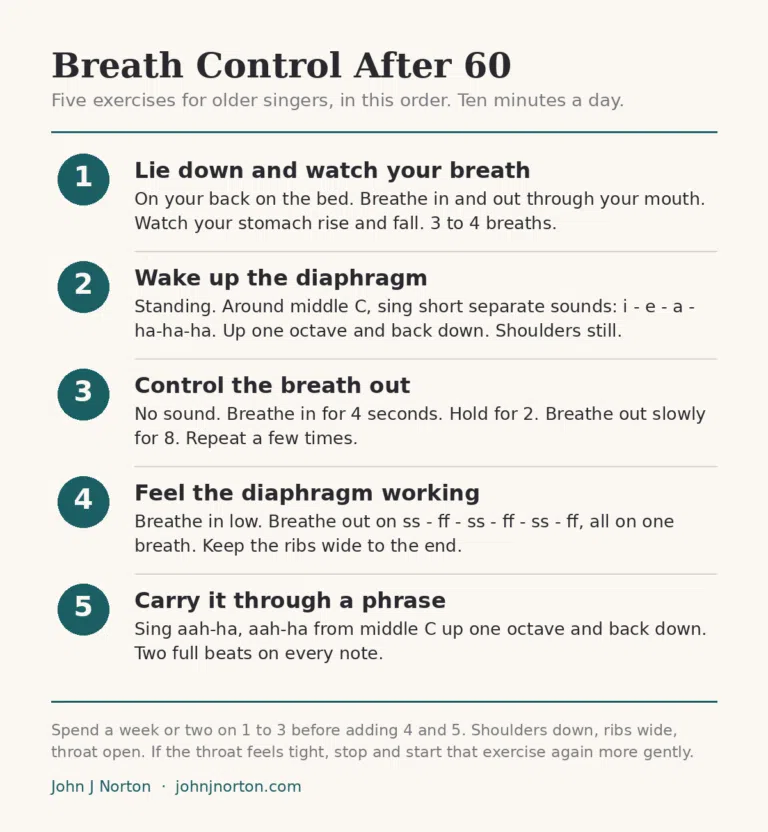
Exercises work best when they are quiet enough to be accurate. Begin in a comfortable part of the range and stop before fatigue sets in. Quality repetition teaches coordination; repeated strain teaches the body to brace.
A few useful options are:
- Lip trills or tongue trills: Glide slowly from a comfortable low note to a comfortable high note and back. The gentle resistance encourages steady airflow and reduces the temptation to press.
- Hums on “mm” or “ng”: Slide through the transition area with a relaxed, forward sensation. Keep the volume moderate and notice whether the sound remains connected.
- Sirens on “woo”: A soft “woo” can help the voice release excess chest weight. Let the sound travel smoothly rather than trying to make every pitch equally loud.
- Five-note scales on “gee” or “nay”: Used lightly, these can encourage clarity and closure in a breathy voice. If they create tightness, reduce the volume and choose an easier starting pitch.
Do not use one exercise as a cure-all. A singer with a pressed upper register may benefit from rounded, soothing sounds, while a singer whose voice disconnects too early may need a little more focused, speech-like energy. This is why individualized listening matters more than a generic list of vocal drills.
Bring the coordination into a song
After an exercise, sing only the two or three notes around the difficult passage. Use a simple vowel first, then add the words. Practice the phrase at an easy volume before attempting the full emotional intensity of the piece. If it works slowly but disappears at performance volume, do not simply sing louder. Check whether the vowel, breath, or physical tension changed when you increased the energy.
It also helps to decide what the phrase needs musically. A lyrical classical line may need a longer breath and a gradual vowel adjustment. A belt-influenced musical-theater moment may need a brighter, more speech-connected mix. Neither approach is automatically healthier or more expressive. The appropriate choice depends on your voice, the style, the pitch, and how often you need to sing that passage.
Avoid practicing through pain or persistent hoarseness
Momentary awkwardness while developing a new coordination is normal. Pain, burning, persistent hoarseness, or a noticeable loss of range is not a technique problem to push through. Rest the voice and seek appropriate medical guidance when symptoms continue. Good training builds capacity over time; it does not demand that the voice ignore warning signs.
A skilled teacher can also help distinguish between a genuine register issue and a problem created by posture, breath habits, an unsuitable key, or a song that is simply not sitting well for your current stage of development. In one-to-one coaching, small adjustments can be heard and refined much more effectively than they can be guessed at alone.
The register shift that frustrates you now can become one of the most expressive parts of your voice. Give it patient, intelligent attention, and allow the coordination to change rather than asking the voice to fight its way upward.
Want to work on this with me?
I'm John J Norton, a professional singer and vocal coach. I teach one-to-one online, wherever you are in the world.
Want to go beyond reading?
Put this into practice with my step-by-step online course — the first 3 lessons are free to try.
Explore the Online Singing Course