Breath Control for Singing After 60: Five Exercises That Rebuild Support
Breath is the first thing to go. Before the high notes, before the tone, the breath runs out two bars early, and the shoulders start doing the work the diaphragm used to do. If you sing in a choir and you're over 60, you've probably felt it.
It isn't your lungs giving up. Most singers were never taught to breathe. When you were younger, a strong body covered for that. It doesn't any more.
I'm John J Norton, a professional singer and vocal coach. I teach one-to-one online, wherever you are in the world. Book a free 15-minute call.
I'm 63. I sang professionally for more than 20 years. I still warm up for 40 minutes, and breathing is the first thing I do. One of my students, a retired teacher who had sung all her life, found breathing the hardest part of rebuilding her voice, because nobody had ever shown her how. Two years on, it's still the thing she works at most.
So here is what I teach. Five exercises, in this order. Ten minutes a day. Gently.
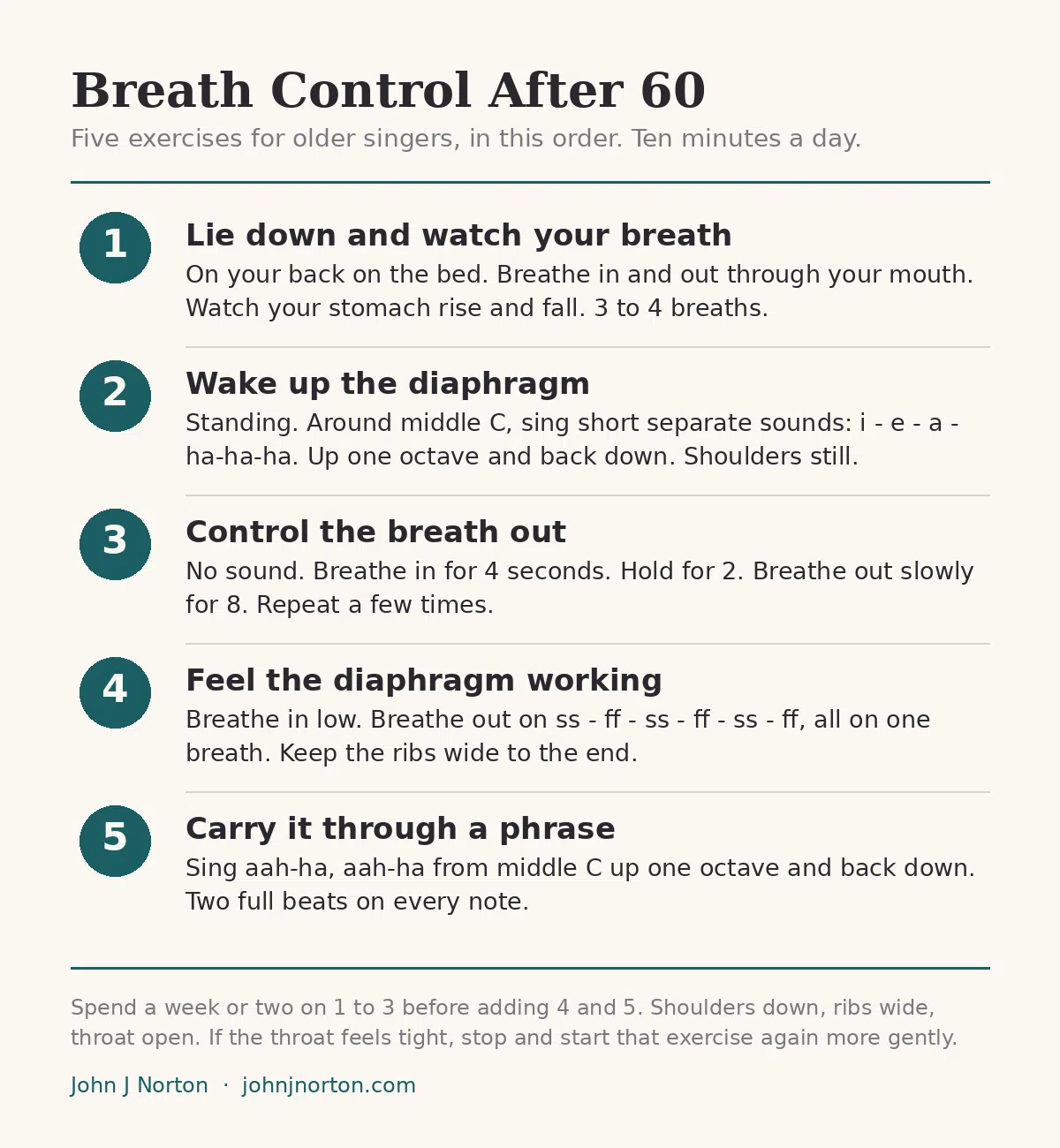
1. Lie down and watch your breath
On your back on the bed. Breathe in and out through your mouth. Watch your stomach rise and fall. Three or four breaths. This is how you breathe every night in your sleep. Lying down takes the shoulders out of it, and it's easy on the back. Everything starts here.
2. Wake up the diaphragm
Standing, or sitting tall if standing tires you. Around middle C, sing short separate sounds: i, e, a, ha-ha-ha. Up one octave and back down. Each sound comes from the diaphragm, not the throat. Shoulders still.
3. Control the breath out
No sound. Breathe in for 4 seconds. Hold for 2. Breathe out slowly for 8. If 8 is too long at first, do 6 and build up. Repeat a few times. This is where breath control is really built.
4. Feel the diaphragm working
Breathe in low. Breathe out on ss, ff, ss, ff, ss, ff, all on one breath. Keep the ribs wide to the end.
5. Carry it through a phrase
Sing aah-ha, aah-ha from middle C up one octave and back down. Two full beats on every note. If the top feels pushed, don't push. Go back to 3 and 4 for a few days.
How to practise
Every day, but never to the point of strain. Spend a week or two on 1 to 3 before adding 4 and 5.
Watch for shoulders lifting, ribs collapsing, or a tight throat. If anything hurts or feels tight, stop, breathe out, and start again more gently.
Breathing isn't learned once. It's kept up, like walking every day. Give it four weeks and notice what's changed at the end of the phrase.
What next
If your high notes have gone too, read Losing your high notes after 60. It explains why, and what comes back.
If you'd like me to show you these exercises on screen, that's my online course, Lumi Voice: Breathing Fundamentals. Twelve short lessons; the first three are free. The full method is in my book, Your Voice Isn't Broken, or you can book a session with me through the website.
Want to work on this with me?
I'm John J Norton, a professional singer and vocal coach. I teach one-to-one online, wherever you are in the world.
Want to go beyond reading?
Put this into practice with my step-by-step online course — the first 3 lessons are free to try.
Explore the Online Singing Course