Singing Posture for Better Projection
If your voice feels strong in the practice room but disappears the moment you try to fill a space, posture is often part of the problem. Singing posture for better projection is not about standing stiffly or looking formal. It is about organizing the body so breath, resonance, and vocal freedom can work together without unnecessary resistance.
Many singers assume projection is mainly about volume. In practice, it is more precise than that. A well-projected voice carries because the sound is efficiently produced and clearly resonated, not because the singer is pushing harder. Good posture gives your instrument the space and balance it needs to do exactly that.
I'm John J Norton, a professional singer and vocal coach. I teach one-to-one online, wherever you are in the world. Book a free 15-minute call.
Why posture affects projection so much
Projection begins before the sound leaves your mouth. If the head is pushed forward, the ribs are collapsed, or the knees are locked, the body has to work around tension and imbalance. That usually shows up as shallow breathing, a tight jaw, a pressed throat, or a tone that feels trapped instead of released.
When posture is aligned, breath management becomes easier. The torso can expand more naturally, the neck remains freer, and the larynx is less likely to be pulled into excess tension. The result is a tone that travels better, feels steadier, and requires less effort.
This is one of the most misunderstood parts of vocal technique. Posture does not create projection on its own, but poor posture can quietly sabotage it. If you have ever felt that you were doing more and getting less, that trade-off is often the clue.
What good singing posture actually looks like
The phrase singing posture for better projection can sound abstract until you know what to feel. In simple terms, you want a posture that is grounded, lifted, and mobile at the same time.
Start from the feet. They should feel stable under you, usually about hip-width apart, with weight balanced rather than dumped into the heels or toes. The knees stay released, not rigid. That small detail matters more than many singers realize, because locked knees often create a chain of tension upward through the pelvis and torso.
The pelvis should feel neutral, not tucked aggressively under and not tilted forward. From there, think of the spine lengthening upward. This is not military posture. You are aiming for buoyancy, not stiffness.
The rib cage should feel open and comfortably suspended, without flaring. If the chest is collapsed, breath support becomes harder. If the chest is over-lifted, the body often becomes artificially tense. The middle ground is what serves the voice best.
Your shoulders should rest wide and easy. They do not need to be pulled back. In fact, that common correction often creates more tension across the upper body. The neck remains free, and the head balances on top of the spine rather than jutting forward. The chin should be level most of the time, with enough freedom to avoid compressing the throat.
Common posture mistakes that weaken projection
The first is the classic raised chest with a held breath feeling. It can look confident from the outside, but it usually reduces flexibility in breathing and encourages throat effort.
The second is collapse. This is common in singers who are trying to relax but end up dropping through the sternum and upper back. The body then loses the structural support that helps the voice carry.
Another frequent issue is the forward head position. Even a slight jut of the chin can tighten the tongue and neck, which affects resonance more than people expect. If the sound feels stuck at the root of the tongue or tiring after a few phrases, this is worth checking.
Then there is overcorrection. Some singers work so hard to stand correctly that they become frozen. Projection needs coordinated movement. If posture becomes a fixed pose, breath and expression both suffer.
How to find singing posture for better projection in real time
The best posture cues are the ones you can actually use while singing, not the ones that sound impressive in theory. Start by standing with your feet under your hips and gently shifting your weight forward and back until you find the middle. Then let the knees soften.
Place one hand on your lower ribs and inhale silently. Notice whether the rib cage can widen without the shoulders lifting. If the shoulders rise first, you are probably trying to inhale too high in the body. Projection improves when breath is lower, wider, and less dramatic.
Now imagine the back of the neck widening as the crown of the head floats upward. That cue often works better than trying to pin the shoulders down or force the chest up. It gives you length without rigidity.
As you sing, keep checking for unnecessary effort in the jaw, tongue, and throat. Posture is not only what your skeleton is doing. It is also what your body is no longer interfering with. A freer alignment often leads to an immediate improvement in clarity and ring.
The role of breath in posture and projection
Projection depends on breath pressure being managed well, not dumped into the sound. Posture supports that management by giving the ribs and abdominal system room to respond.
If you collapse at the start of the phrase, the breath tends to rush out. If you brace too hard in the abdomen, the tone can become pressed or inflexible. Good alignment allows the breath to stay dynamic. You are not holding the body still. You are allowing it to coordinate.
This is where individualized coaching matters. One singer may need more grounding through the legs. Another may need to release the upper chest and jaw. The principle is shared, but the correction is rarely identical from one person to the next.
Posture changes when you sing different styles
The fundamentals stay consistent, but style does affect how posture is expressed. A classical singer may work with a more visibly buoyant and spacious setup through the torso. A musical theater or contemporary singer may use more conversational movement and varied physical gesture.
What should not change is efficiency. If dramatic movement disturbs breath balance, projection will usually drop. If stillness becomes rigidity, the same thing happens. The goal is not to eliminate personality from performance. It is to build technique that remains reliable while you communicate.
This also matters for professionals who use the speaking voice. The body patterns that weaken a sung phrase often weaken spoken presence too. Head-forward posture, collapsed ribs, and jaw tension can make a presentation sound smaller, flatter, and less persuasive.
Simple ways to practice better posture
Use a mirror occasionally, but do not become dependent on it. Visual feedback is useful, yet internal awareness is what makes change last.
Wall work can help. Stand with your back near a wall so you can notice whether the head is thrusting forward or the lower back is overarched. The wall is only a reference point, not a final singing position.
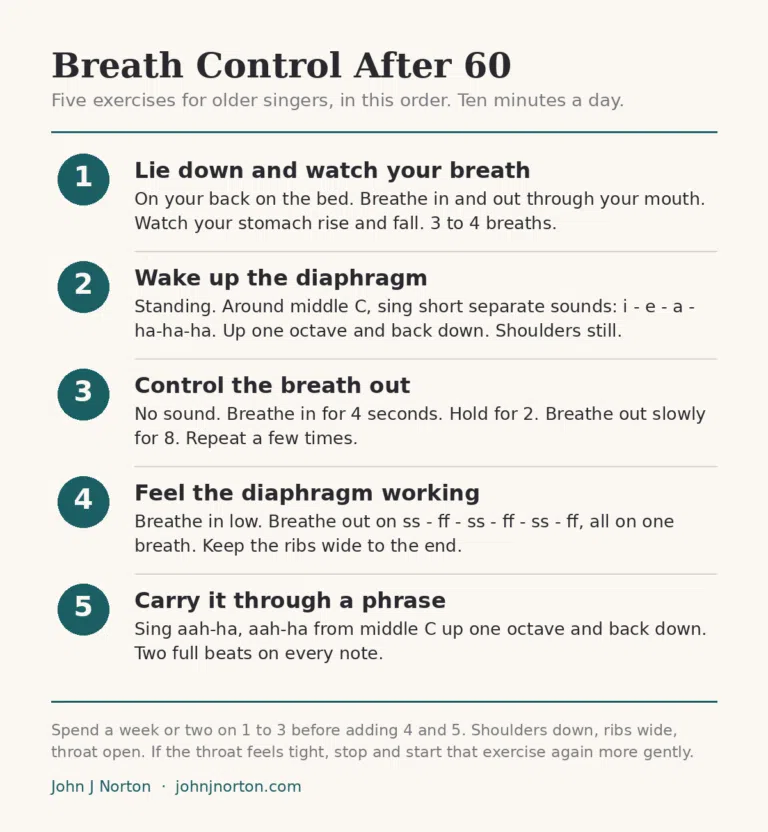
Slow breathing exercises are also useful, especially if you tend to grip in the chest or abdomen. Inhale quietly, feel the ribs widen, then exhale on a comfortable hiss while keeping the sternum easy and lifted. After that, sing a simple phrase and notice whether the body can stay organized without becoming rigid.
Recording yourself is another practical test. Often the voice tells the truth before the body does. If posture improves, you may hear more steadiness, more ring, and less forcing even before the change feels natural.
When posture is not the whole answer
Posture is powerful, but it is not magic. If projection is still weak after alignment improves, the issue may also involve breath timing, vowel shaping, tongue tension, registration, or inefficient resonance strategy.
That is why broad advice has limits. Telling every singer to stand tall and breathe deeply is not enough. Effective technical work looks at the full coordination of the instrument. In coaching, posture is often the door into a larger solution rather than the entire solution itself.
At John J Norton Voice Zone, this is approached as part of integrated vocal function, not as a cosmetic correction. The body, breath, and sound have to cooperate if you want a voice that carries consistently and feels dependable under pressure.
A better posture should make singing feel more possible, not more controlled. If your body is organized well, projection stops feeling like a contest of force and starts feeling like a release of sound with direction, focus, and confidence. That is the kind of change worth building carefully.
Want to work on this with me?
I'm John J Norton, a professional singer and vocal coach. I teach one-to-one online, wherever you are in the world.
Want to go beyond reading?
Put this into practice with my step-by-step online course — the first 3 lessons are free to try.
Explore the Online Singing Course