How to Project Your Voice Naturally
You can usually hear the problem before you can name it. Someone is trying to speak up or sing out, but the sound turns tight, pushed, or oddly thin. They are working harder, yet the voice carries less. If you want to learn how to project your voice naturally, the goal is not to become louder by force. It is to build a voice that travels clearly, efficiently, and without unnecessary tension.
That distinction matters whether you are singing in rehearsal, leading a meeting, teaching a room, or giving a presentation where people need to trust what they hear. Real projection is not shouting. It is coordinated vocal function.
I'm John J Norton, a professional singer and vocal coach. I teach one-to-one online, wherever you are in the world. Book a free 15-minute call.
What natural voice projection actually means
Natural projection happens when breath, vocal fold closure, resonance, and articulation work together. The sound feels present and energized, but not jammed into the throat. You are not pressing for volume. You are allowing the voice to carry.
Many people assume projection starts at the mouth because that is where the sound comes out. In practice, it starts much earlier. Your body organizes breath, your vocal folds convert that airflow into sound, and your vocal tract shapes that sound into something focused enough to reach the listener. If one part is off, the usual response is to compensate. That is when people push from the throat, tense the jaw, or lift the chin and hope for more volume.
The trade-off is simple. You may get a burst of loudness, but you lose stamina, clarity, and tonal freedom. For singers, that often means instability and fatigue. For speakers, it can mean sounding strained or less authoritative.
Why forcing the voice makes projection worse
When people try to be heard, they often increase muscular effort in the wrong places. The neck tightens, the tongue stiffens, and the breath becomes shallow. It feels active, so it seems productive. Usually, it is not.
A forced voice often loses resonance because the vocal tract is no longer free enough to amplify the sound well. It also becomes less responsive. You may notice the voice cracking under pressure, words becoming less distinct, or tone flattening when you need it most.
This is why two people in the same room can seem equally loud up close, but only one is easy to hear at the back. Projection is not just about decibels. It is about efficiency and acoustic focus.
How to project your voice naturally without shouting
The first step is posture, but not the stiff version many people were taught. You do not need a military stance. You need balance. Let the head rest over the spine, the chest feel open without being lifted rigidly, and the knees stay easy rather than locked. Good alignment gives the breath room to move and keeps the throat from doing extra work.
Next comes breath. Projection depends on steady airflow, not a huge dramatic inhale. If you gasp or lift the shoulders, you often create tension before you even make a sound. Instead, allow the breath to drop lower into the torso and sides of the ribs. The sensation should be expansive, not inflated.
Then think about the onset of sound. If the voice begins with a hard attack, the sound tends to feel pressed. If it begins too breathy, it lacks core. The ideal is a clean, balanced start, where breath and tone meet at the same moment. That coordination is one of the foundations of healthy projection.
Resonance is where natural carrying power develops. When the vocal tract is shaped well, the voice gains ring and presence. You do not create that by squeezing. You create it by keeping the jaw free, the tongue released, and the vowels clear enough for the sound to organize itself. This is why a well-produced voice can fill a room without sounding aggressive.
Finally, your words need shape. For speakers especially, articulation can do as much for projection as volume. Crisp consonants and clean vowels help the listener receive the message without strain. If your diction is lazy, people perceive the voice as weaker, even when you are technically loud enough.
The body habits that help the voice carry
Projection is affected by physical habits you may not associate with the voice at all. If your chest collapses as you speak, support drops away. If your jaw clenches when you concentrate, resonance narrows. If you habitually push your chin forward toward a screen, your throat often tightens before the voice begins.
That does not mean you need perfect posture all day. It means awareness matters. Small adjustments are often enough. Release the back of the neck. Let the shoulders rest. Feel the breath widen the ribs. These changes can create immediate improvement because they remove obstacles rather than adding effort.
There is also a psychological element. Many people reduce their sound because they are trying not to disturb others, not take up space, or not appear too expressive. Then, when they need more projection, they overcorrect and push. A natural voice sits between those extremes. It is grounded, not apologetic, and not aggressive.
Simple practice for stronger natural projection
One useful exercise is sustained humming on a comfortable pitch. If the hum feels buzzy around the lips and face, that is often a sign the voice is resonating efficiently. If it feels trapped in the throat, ease back and reduce pressure. The point is not to make the biggest sound. It is to find the easiest one with presence.
From there, move into simple speech phrases. Say something like, “Good morning, everyone,” or “Let’s begin here,” and aim for clarity and ease rather than loudness. Imagine the sound traveling forward to a specific listener across the room. That mental focus often improves projection more effectively than trying to sound bigger.
For singers, gentle scales on resonant consonants such as M, N, or NG can help organize breath and resonance without forcing volume. For speakers, reading a paragraph aloud with energized consonants can improve carry quickly. In both cases, stop if the throat starts to grip. Productive practice should build coordination, not fatigue.
It also helps to vary the room. A voice that feels easy in a small office may not carry well in a larger space. Practice speaking or singing in different environments and notice what changes. Usually, people do not need dramatically more effort in a larger room. They need more focus, better pacing, and cleaner articulation.
Common mistakes when learning how to project your voice naturally
One common mistake is confusing projection with sheer volume. Louder is not always clearer. In fact, excessive volume often distorts the very qualities that help the voice carry.
Another is overbreathing. People are told to “take a deep breath,” then inhale so much that the body becomes rigid. Too much air can be just as unhelpful as too little. You want available breath, not overloaded breath.
A third issue is trying to copy someone else’s sound. A naturally resonant baritone, a bright soprano, and a persuasive speaking voice will not all project in the same way. Your voice has its own acoustical strengths. Good training develops those strengths rather than forcing an imitation.
And then there is impatience. If you have spent years pushing to be heard, the efficient setup may feel unfamiliar at first. Some people assume that because it feels easier, it must be weaker. Usually the opposite is true.
When projection needs individual coaching
If your voice tires quickly, disappears under stress, or becomes hoarse after rehearsals, meetings, or teaching, generic advice may not be enough. The reason one person struggles with projection may be breath management, while another needs resonance work, better articulation, or release of unnecessary tension. The symptom looks similar. The solution is not always the same.
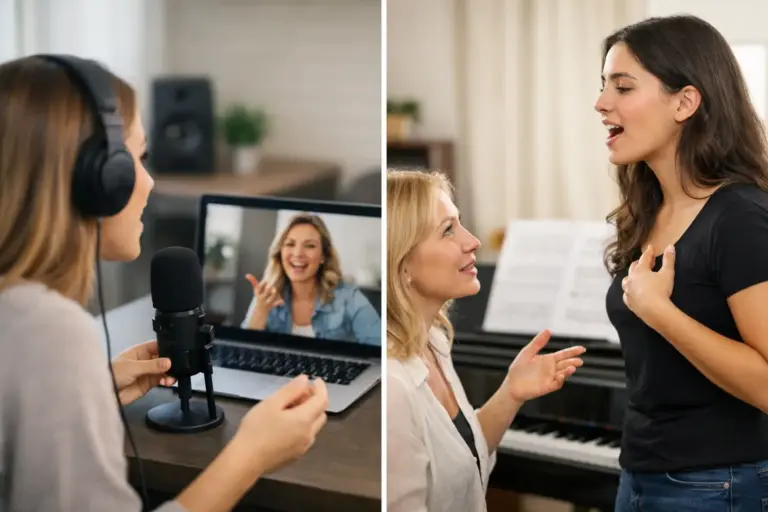
That is where individualized coaching becomes valuable. A trained ear can hear whether the issue is breathy tone, pressed phonation, poor vowel shaping, or a speaking habit that undermines authority. In coaching, the goal is not simply a bigger sound. It is a healthier and more dependable one.
At John J Norton Voice Zone, this kind of work is approached as both technical and personal. A stronger voice is not just about sound production. It changes how you perform, how you communicate, and how confidently you occupy the room.
A well-projected voice does not feel artificial. It feels like your own voice, working properly. That is the standard worth aiming for - not more force, but more freedom.
Want to work on this with me?
I'm John J Norton, a professional singer and vocal coach. I teach one-to-one online, wherever you are in the world.
Want to go beyond reading?
Put this into practice with my step-by-step online course — the first 3 lessons are free to try.
Explore the Online Singing Course